Miniport Code
Do you need to create virtual devices?
 We offer precision source code to jump start your development putting you close to the finish line right from the start. |
Each sample offers the following features:
- Creates virtual disk drives that are assigned drive letters and are indistinguishable from real disk drives
- Supports Windows 10 & 11, Server 2019 & 2022
- Uses the newest extended SCSI request block technology (SRB_TYPE_STORAGE_REQUEST_BLOCK)
- Supports bidirectional and 32-byte CDBs
- Supports disk drives larger than 2TB (long lba addressing)
- installer and uninstaller included
- C++20 framework. Provide easy context data per request, per device, and per adapter.
- Stable and mature technology refined over many years
- Verifier clean, /W4 and /Wall clean, passes ScsiComplianceTest in the Windows HLK
- SPC-5 and SBC-4 command set compliance
| Sample Name: | UVStor | StorFile | StorRaid |
| Ideal for: | virtual devices | virtual devices | software RAID |
| Example Device: | file mounted as a disk drive | file mounted as a disk drive | RAID |
| Key Features: |
Create devices from a Windows application.
No device driver development needed. Perfect for virtual disks, DVD drives, devices with a network backend, and other virtual devices. |
Develop a standalone virtual storport miniport driver. Perfect for virtual disks, DVD drives, devices with a network backend, and other virtual devices. All of your code runs at PASSIVE_LEVEL making it ideal to call any WDK functions. Easily add and remove devices dynamically for excellent device lifetime control. Exploits overlapped request queuing and fast, asynchronous back ends. Kernel level code to read and write a sparse disk file using asynchronous file I/O. Each device gets a dedicated thread for optimum multi-core performance. Persistent settings across system restarts using StorPortRegistryReadAdapterKey / StorPortRegistryWriteAdapterKey Utilizes HwStorProcessServiceRequest, StorPortCompleteServiceIrp, and IOCTL_MINIPORT_PROCESS_SERVICE_IRP supports WRITE LONG to simulate media errors. pass information to the miniport driver from the inf file. Includes a utility that passes adapter and device specific IOCTLs to the miniport driver. |
Create stripes and mirrors. Disks can be added to a mirror while it is running. High performance I/O algorithms with write caching.  Includes a raid management tool. Multiple RAIDs can be created and run simultaneously. Selectable stripe sector interleave for high performance Supports any sector size including 512 and 4K. Disk drives allocated to a RAID are not assigned drive letters by Windows. Disk drives allocated to a RAID are formatted with a GPT partition encapsulating the RAID data. Single device driver solution. Enterprise quality, ready to ship software RAID solution. |
| Try for free | Download UVStor | Download StorFile | Download StorRaid |
| Price (USD): | $6000 | $6000 | $36,000 |
| Buy: |
|
|
|
FAQ:
How long does it take to get?
The software is delivered electronically. You can download and start using the source code instantly after entering your order. Online ordering is safe and secure by credit card. We accept purchase orders.
What comes with each sample?
You get the carefully articulated and well documented source code which can be built using Visual Studio 2019, documentation covering all you need to know to use the source, an installer/uninstaller, and a pre-built ready to run driver.
Can the disk name be customized?
Yes. Both the disk and adapter name can be customized. Below is an example of what appears in device manager:
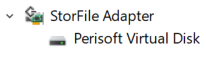
Are there limits on the devices?
You may define multiple devices and devices of any SCSI type (eg: hard disk, DVD, printer).
What is the API like?
UVStor: Customize simple, ready to go usermode c++ classes to the needs of your device. There are 3 classes: the Adapter, the Device, and the Request.
StorFile: Customize simple, ready to go device driver c++ classes to the needs of your device. There are 3 classes: the Adapter, the Device, and the Request. All of your functions are called at PASSIVE_LEVEL for convenience. And callbacks can be called at DISPATCH_LEVEL or below for convenience such as request completion.
StorRaid: The device driver is a complete, ready to go software RAID solution. It includes an IOCTL interface to manage RAIDs.
What technical support is provided?
Free support for 90 days and a full refund policy.
Are there any royalties or other costs?
No. You are free to modify the source and use it for as many products as you wish in any sales volume. There is also no time limit on how long you can use the source.
What is the license agreement?
Featured Customers: